
İçeriğe atla
  • +90 (312) 290 2513
  • unam@unam.bilkent.edu.tr
  • UNAM Altyapı : +90 (312) 290 80 45
  • UNAM-IS
  • EN
Ara
Close this search box.
  • Ana Menü
    • Haberler
    • Etkinlikler
      • Tüm Etkinlikler
      • Nano Günler
      • NanoArt
      • NanoKolokyumlar
      • Perşembe Seminerleri
      • UNAM Bilim Atölyesi
    • Duyurular
    • Multimedya
      • Multimedya
      • Kurumsal Kimlik
    • İletişim
  • Kurumsal
    • Misyon-Vizyon-Stratejik Hedefler-Değerler
    • Hakkımızda
    • Yönetimin Mesajı
    • UNAM 6550
    • Faaliyet Raporları
    • Sayılarla UNAM
    • Ekibimiz
      • Organizasyon Şeması
      • Yönetim Kurulu
      • UNAM Yönetimi
      • Proje Yürütücüleri
      • UNAM İdari Ekip
      • UNAM Teknik Ekipleri
      • Proje Mühendisleri
      • Doktora Sonrası Araştırmacılar
      • UNAM Ziyaretçi Bilim İnsanları
      • MSN Lisansüstü Öğrencileri
      • Diğer Lisansüstü Öğrencileri
      • Doktora Mezunları
      • Yüksek Lisans Mezunları
      • Tezler
    • Ödüller
      • Fakülte Ödülleri
      • Araştırmacı ve Öğrenci Ödülleri
    • İş Ekosistemi
    • Kariyer
    • UNAM’da Toplumsal Cinsiyet Eşitliği
      • Cinsiyet Eşitliği Planı
      • Cinsiyet Eşitliği Kapasite Değerlendirme Anketi Analiz Raporu
  • Araştırma
    • Araştırma Alanları
    • Projeler
    • Yayınlar
    • Patentler
    • Araştırma Grupları
  • Eğitim
    • Eğitim
    • MSN Programı
      • MSN Yüksek Lisans Programı
      • MSN Doktora Programı
      • Tez Teslim ve Onay Süreci
    • UNAM Burs Olanakları
    • MSN Dersleri
    • Staj Başvuru Formu
    • HST
    • Mezunlar
      • Yüksek Lisans Mezunları
      • Doktora Mezunları
      • Tezler
  • Altyapı
    • UNAM Altyapısı
    • Altyapı Hizmet Bedeli
    • UNAM-IS
    • UNAM Store
    • UNAM Rentals
    • İş Güvenliği
    • Altyapı Kuralları
Menü
  • Ana Menü
    • Haberler
    • Etkinlikler
      • Tüm Etkinlikler
      • Nano Günler
      • NanoArt
      • NanoKolokyumlar
      • Perşembe Seminerleri
      • UNAM Bilim Atölyesi
    • Duyurular
    • Multimedya
      • Multimedya
      • Kurumsal Kimlik
    • İletişim
  • Kurumsal
    • Misyon-Vizyon-Stratejik Hedefler-Değerler
    • Hakkımızda
    • Yönetimin Mesajı
    • UNAM 6550
    • Faaliyet Raporları
    • Sayılarla UNAM
    • Ekibimiz
      • Organizasyon Şeması
      • Yönetim Kurulu
      • UNAM Yönetimi
      • Proje Yürütücüleri
      • UNAM İdari Ekip
      • UNAM Teknik Ekipleri
      • Proje Mühendisleri
      • Doktora Sonrası Araştırmacılar
      • UNAM Ziyaretçi Bilim İnsanları
      • MSN Lisansüstü Öğrencileri
      • Diğer Lisansüstü Öğrencileri
      • Doktora Mezunları
      • Yüksek Lisans Mezunları
      • Tezler
    • Ödüller
      • Fakülte Ödülleri
      • Araştırmacı ve Öğrenci Ödülleri
    • İş Ekosistemi
    • Kariyer
    • UNAM’da Toplumsal Cinsiyet Eşitliği
      • Cinsiyet Eşitliği Planı
      • Cinsiyet Eşitliği Kapasite Değerlendirme Anketi Analiz Raporu
  • Araştırma
    • Araştırma Alanları
    • Projeler
    • Yayınlar
    • Patentler
    • Araştırma Grupları
  • Eğitim
    • Eğitim
    • MSN Programı
      • MSN Yüksek Lisans Programı
      • MSN Doktora Programı
      • Tez Teslim ve Onay Süreci
    • UNAM Burs Olanakları
    • MSN Dersleri
    • Staj Başvuru Formu
    • HST
    • Mezunlar
      • Yüksek Lisans Mezunları
      • Doktora Mezunları
      • Tezler
  • Altyapı
    • UNAM Altyapısı
    • Altyapı Hizmet Bedeli
    • UNAM-IS
    • UNAM Store
    • UNAM Rentals
    • İş Güvenliği
    • Altyapı Kuralları

Demonstrate memristor-like operation of thin film Flash memory cells

  • 2015 Yılı Haberleri
  • Temmuz 31, 2015
Demonstrate-memristor-like-operation-of-thin-film-Flash-memory-cells

Memristors, resistors of which conductance is a function of the history of voltage applied to them, have attracted great attention in the present decade as potential components of memory and computing platforms. These long-forgotten device components were predicted over fifty years ago by Leon Chua, who described them as the fourth fundamental circuit element alongside resistors, capacitors and inductors – although the true origins of the memristor are even older than its name, as the term applies to such a broad range of electronic phenomena that the original observations of memristive behavior date over a century ago.

In the modern world, however, memristors are making a comeback: They are expected to play a major role in the development of novel computing platforms, particularly neuromorphic systems, where brain-like (cortical) computational schemes can be efficiently implemented using semiconductor technology. Recent reports on memristive switches demonstrate improvements in the uniformity and controllability of nanoionics-based memristors, though there is still a long way to go before memristors can compete with other circuit elements in forming neuromorphic systems with billions of synapses and millions of solid state neurons. On the other hand, Flash memory -another non-volatile memory technology- has reached very high densities and is readily compatible with CMOS technology, which makes it a particularly suitable model for the implementation of memristor-based applications.

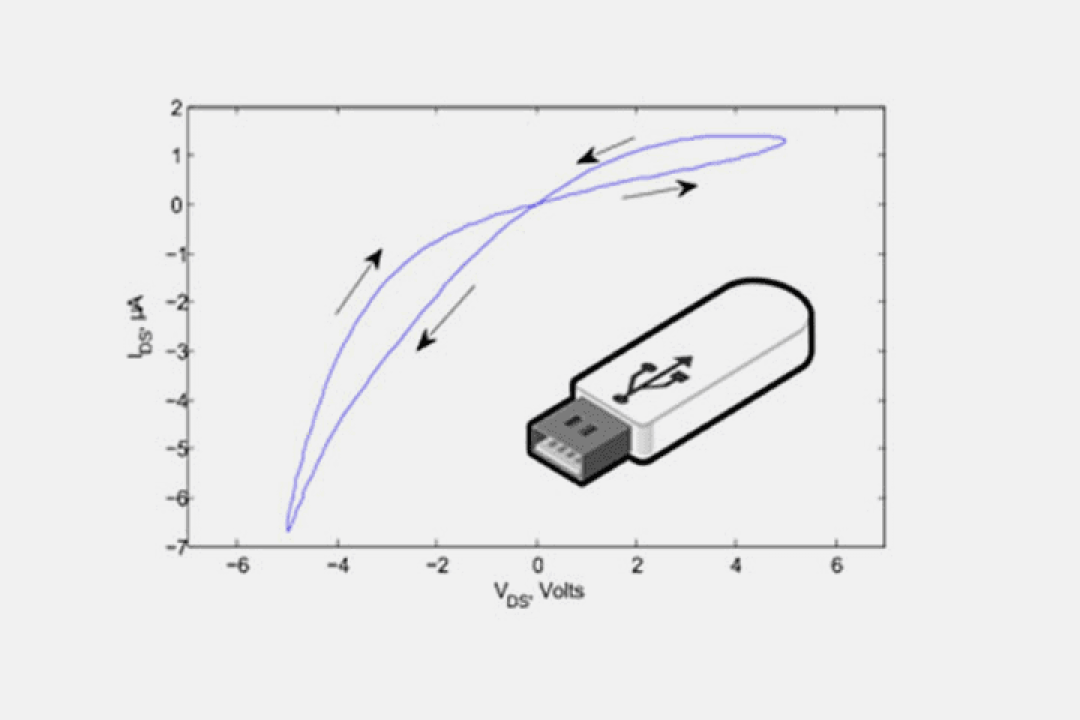
In a recent work published in Applied Physics Letters, Dâna group has demonstrated that junctionless flash memory cells can be operated like a memristor: The write and erase operations commonly performed through voltage pulses applied to the gate can be effected through the application of voltages through the source and drain terminals of the transistor. In fact, the equations that relate the transistor operation and charge/discharge of the floating gate show that the flash memory, when operated in this way, behaves nearly like an ideal memristor. The significance of the demonstration is that it connects the two non-volatile memory device families, the memristor and flash, and may facilitate future applications of flash memory devices in neuromorphic computing. Considering that the density of flash drives has improved to such an extent that multigigabit chips can be mass produced and have entered into virtually every cell-phone, flash technology already has the infrastructure that can enable the implemention of billions of synthetic synapses. Moreover, the flashristor mode -the new operation mode is referred to in the article- can be implemented with high uniformity and repeatability.

The group’s findings are also highlighted in the IEEE Spectrum website, which can be found at:

http://spectrum.ieee.org/tech-talk/computing/hardware/flashristors-getting-the-best-of-memristors-and-flash-memory

Reference:

Orak, I., Ürel, M., Bakan, G., & Dana, A. (2015). Memristive behavior in a junctionless flash memory cell. Applied Physics Letters, 106(23), 233506

Facebook
Twitter
LinkedIn
Pinterest
WhatsApp

Haber bültenimize kayıt olun

Duyuru ve etkinliklerden haberdar olmak için e-mail bültenimize kayıt olabilirsiniz.

Sanal Tur 360°

Multimedya

İletişim

Nanokids

Facebook-f Twitter Instagram Youtube Linkedin Spotify

Bilkent Üniversitesi UNAM
Ulusal Nanoteknoloji Araştırma Merkezi

Malzeme Bilimi ve Nanoteknoloji Enstitüsü

Bilkent Üniversitesi Ankara, 06800, Türkiye
Tel: +90 312 290 2513 Fax: +90 312 266 4365

© Tüm hakları Saklıdır. UNAM Bilgi İşlem 2023

UNAM Bilgi İşlem
