
Skip to the content
  • +90 (312) 290 2513
  • unam@unam.bilkent.edu.tr
  • UNAM Facility : +90 (312) 290 80 45
  • UNAM-IS
  • TR
Search
Close
  • Main Menu
    • News
    • Events
      • Events
      • Nanodays
      • NanoArt
      • Nanocolloquiums
      • Thursday Seminars
      • UNAM Science Workshop
    • Announcements
    • Multimedia
      • Multimedia
      • Corporate identity
    • Contact
  • Corporate
    • Mission-Vision-Strategic Goals-Values
    • About
    • Message from The Director
    • UNAM 6550
    • Annual Reports
    • UNAM by Numbers
    • Our Teams
      • Organization Chart
      • UNAM Board of Governance
      • Director’s Office
      • Principal Investigators
      • Administrative Staff
      • Operations Team
      • Project Engineers
      • Postdoctoral Fellows
      • UNAM Visiting Scholars
      • MSN Graduate Students
      • Other Graduate Students
      • PhD Alumni
      • Ms Alumni
      • Completed Theses
    • Awards
      • Faculty Awards
      • Researcher and Student Awards
    • Business Ecosystem
    • Career
    • Gender Equality at UNAM
      • Gender Equality Plan
      • Gender Equality Capacity Assessment Quentionnaire Analysis
  • Research
    • Research Fields
    • Projects
    • Publications
    • Patents
    • Research Groups
  • Education
    • Education
    • MSN Program
      • MSN Masters Program
      • MSN Ph.D. Program
      • Thesis Submission and Approval Process
    • UNAM Scholarship Opportunities
    • MSN Courses
    • Internship Application Form
    • HST
    • Alumni
      • MS Alumni
      • PhD Alumni
      • Theses
  • Facility
    • UNAM Facility
    • Infrastructure Service Fee
    • UNAM-IS
    • UNAM Store
    • UNAM Rentals
    • Safety
    • Facility Rules
Menu
  • Main Menu
    • News
    • Events
      • Events
      • Nanodays
      • NanoArt
      • Nanocolloquiums
      • Thursday Seminars
      • UNAM Science Workshop
    • Announcements
    • Multimedia
      • Multimedia
      • Corporate identity
    • Contact
  • Corporate
    • Mission-Vision-Strategic Goals-Values
    • About
    • Message from The Director
    • UNAM 6550
    • Annual Reports
    • UNAM by Numbers
    • Our Teams
      • Organization Chart
      • UNAM Board of Governance
      • Director’s Office
      • Principal Investigators
      • Administrative Staff
      • Operations Team
      • Project Engineers
      • Postdoctoral Fellows
      • UNAM Visiting Scholars
      • MSN Graduate Students
      • Other Graduate Students
      • PhD Alumni
      • Ms Alumni
      • Completed Theses
    • Awards
      • Faculty Awards
      • Researcher and Student Awards
    • Business Ecosystem
    • Career
    • Gender Equality at UNAM
      • Gender Equality Plan
      • Gender Equality Capacity Assessment Quentionnaire Analysis
  • Research
    • Research Fields
    • Projects
    • Publications
    • Patents
    • Research Groups
  • Education
    • Education
    • MSN Program
      • MSN Masters Program
      • MSN Ph.D. Program
      • Thesis Submission and Approval Process
    • UNAM Scholarship Opportunities
    • MSN Courses
    • Internship Application Form
    • HST
    • Alumni
      • MS Alumni
      • PhD Alumni
      • Theses
  • Facility
    • UNAM Facility
    • Infrastructure Service Fee
    • UNAM-IS
    • UNAM Store
    • UNAM Rentals
    • Safety
    • Facility Rules

Demonstrate memristor-like operation of thin film Flash memory cells

  • News 2015
  • July 31, 2015
Demonstrate-memristor-like-operation-of-thin-film-Flash-memory-cells

Memristors, resistors of which conductance is a function of the history of voltage applied to them, have attracted great attention in the present decade as potential components of memory and computing platforms. These long-forgotten device components were predicted over fifty years ago by Leon Chua, who described them as the fourth fundamental circuit element alongside resistors, capacitors and inductors – although the true origins of the memristor are even older than its name, as the term applies to such a broad range of electronic phenomena that the original observations of memristive behavior date over a century ago.

In the modern world, however, memristors are making a comeback: They are expected to play a major role in the development of novel computing platforms, particularly neuromorphic systems, where brain-like (cortical) computational schemes can be efficiently implemented using semiconductor technology. Recent reports on memristive switches demonstrate improvements in the uniformity and controllability of nanoionics-based memristors, though there is still a long way to go before memristors can compete with other circuit elements in forming neuromorphic systems with billions of synapses and millions of solid state neurons. On the other hand, Flash memory -another non-volatile memory technology- has reached very high densities and is readily compatible with CMOS technology, which makes it a particularly suitable model for the implementation of memristor-based applications.

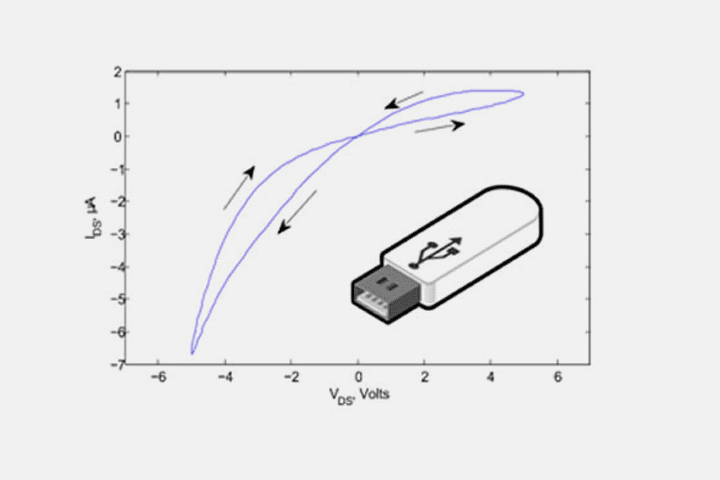
In a recent work published in Applied Physics Letters, Dâna group has demonstrated that junctionless flash memory cells can be operated like a memristor: The write and erase operations commonly performed through voltage pulses applied to the gate can be effected through the application of voltages through the source and drain terminals of the transistor. In fact, the equations that relate the transistor operation and charge/discharge of the floating gate show that the flash memory, when operated in this way, behaves nearly like an ideal memristor. The significance of the demonstration is that it connects the two non-volatile memory device families, the memristor and flash, and may facilitate future applications of flash memory devices in neuromorphic computing. Considering that the density of flash drives has improved to such an extent that multigigabit chips can be mass produced and have entered into virtually every cell-phone, flash technology already has the infrastructure that can enable the implemention of billions of synthetic synapses. Moreover, the flashristor mode -the new operation mode is referred to in the article- can be implemented with high uniformity and repeatability.

The group’s findings are also highlighted in the IEEE Spectrum website, which can be found at:

http://spectrum.ieee.org/tech-talk/computing/hardware/flashristors-getting-the-best-of-memristors-and-flash-memory

Reference:

Orak, I., Ürel, M., Bakan, G., & Dana, A. (2015). Memristive behavior in a junctionless flash memory cell. Applied Physics Letters, 106(23), 233506

Facebook
Twitter
LinkedIn
Pinterest
WhatsApp

Sign up for our newsletter

You can sign up for our e-mail newsletter to be informed about announcements and events.

Sanal Tur 360°

Multimedya

İletişim

Nanokids

Facebook-f Twitter Instagram Youtube Linkedin Spotify

Bilkent University UNAM
National Nanotechnology Research Center

 Institute of Materials Science and Nanotechnology

Bilkent University Ankara, 06800, Turkey
Tel: +90 312 290 2513 Fax: +90 312 266 4365

© All Rights Reserved. UNAM 2023

UNAM IT
