Skip to the content
  • +90 (312) 290 2513
  • unam@unam.bilkent.edu.tr
  • UNAM Facility : +90 (312) 290 80 45
  • UNAM-IS
  • TR
Search
Close
  • Main Menu
    • News
    • Events
      • Events
      • Nanodays
      • NanoArt
      • Nanocolloquiums
      • Thursday Seminars
      • UNAM Science Workshop
    • Announcements
    • Multimedia
      • Multimedia
      • Corporate identity
    • Contact
  • Corporate
    • Mission-Vision-Strategic Goals-Values
    • About
    • Message from The Director
    • UNAM 6550
    • Annual Reports
    • UNAM by Numbers
    • Our Teams
      • Organization Chart
      • UNAM Board of Governance
      • Director’s Office
      • Principal Investigators
      • Administrative Staff
      • Operations Team
      • Project Engineers
      • Postdoctoral Fellows
      • UNAM Visiting Scholars
      • MSN Graduate Students
      • Other Graduate Students
      • PhD Alumni
      • Ms Alumni
      • Completed Theses
    • Awards
      • Faculty Awards
      • Researcher and Student Awards
    • Business Ecosystem
    • Career
    • Gender Equality at UNAM
      • Gender Equality Plan
      • Gender Equality Capacity Assessment Quentionnaire Analysis
  • Research
    • Research Fields
    • Projects
    • Publications
    • Patents
    • Research Groups
  • Education
    • Education
    • MSN Program
      • MSN Masters Program
      • MSN Ph.D. Program
      • Thesis Submission and Approval Process
    • UNAM Scholarship Opportunities
    • MSN Courses
    • Internship Application Form
    • HST
    • Alumni
      • MS Alumni
      • PhD Alumni
      • Theses
  • Facility
    • UNAM Facility
    • Infrastructure Service Fee
    • UNAM-IS
    • UNAM Store
    • UNAM Rentals
    • Safety
    • Facility Rules
Menu
  • Main Menu
    • News
    • Events
      • Events
      • Nanodays
      • NanoArt
      • Nanocolloquiums
      • Thursday Seminars
      • UNAM Science Workshop
    • Announcements
    • Multimedia
      • Multimedia
      • Corporate identity
    • Contact
  • Corporate
    • Mission-Vision-Strategic Goals-Values
    • About
    • Message from The Director
    • UNAM 6550
    • Annual Reports
    • UNAM by Numbers
    • Our Teams
      • Organization Chart
      • UNAM Board of Governance
      • Director’s Office
      • Principal Investigators
      • Administrative Staff
      • Operations Team
      • Project Engineers
      • Postdoctoral Fellows
      • UNAM Visiting Scholars
      • MSN Graduate Students
      • Other Graduate Students
      • PhD Alumni
      • Ms Alumni
      • Completed Theses
    • Awards
      • Faculty Awards
      • Researcher and Student Awards
    • Business Ecosystem
    • Career
    • Gender Equality at UNAM
      • Gender Equality Plan
      • Gender Equality Capacity Assessment Quentionnaire Analysis
  • Research
    • Research Fields
    • Projects
    • Publications
    • Patents
    • Research Groups
  • Education
    • Education
    • MSN Program
      • MSN Masters Program
      • MSN Ph.D. Program
      • Thesis Submission and Approval Process
    • UNAM Scholarship Opportunities
    • MSN Courses
    • Internship Application Form
    • HST
    • Alumni
      • MS Alumni
      • PhD Alumni
      • Theses
  • Facility
    • UNAM Facility
    • Infrastructure Service Fee
    • UNAM-IS
    • UNAM Store
    • UNAM Rentals
    • Safety
    • Facility Rules

Elementary mathematics brings Star Trek’s Holodeck closer to reality

  • News 2019
  • February 16, 2019
2105032020

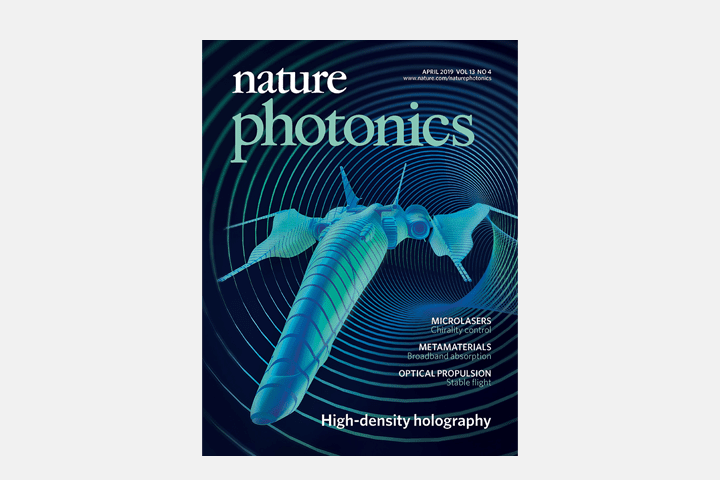
For many years we have been hearing that holographic technology is one step closer to realizing Star Trek’s famous Holodeck, a virtual reality stage that simulates any object in 3D as if they are real. Sadly, 3D holographic projection has never been realized. A team of scientists from Bilkent University and UNAM, again raised our hopes on Holodeck realization by showing the first realistic 3D holograms that can be viewed from any angle. Dr. Ghaith Makey, the lead author of the paper appearing in the April 2019 issue of Nature Photonics today, says “Our technique can work in realtime, and will surely pave the way to dynamic 3D video holography. Soon, it may be possible to create a simple version of a Holodeck”.

3D holographic projection relies on back-to-back stacking of a large number of 2D images. The problem is, they cross-talk! Interference between the images makes the 3D projection fuzzy and far from realistic looking. The expectations have always been placed on the development of optical technology. Prof. F. Ömer Ilday, the team leader, disagrees: “The reason of this cross-talk is the mathematics, not shortcomings of the physical components. Any pair of high-dimensional mutually random vectors tend to be orthogonal. This basic result is a consequence of the Central Limit Theorem and the Law of Large Numbers. We use this property, together with a neat, but traightforward wavefront engineering trick to add random phase to each image, to eliminate cross-talk without using any additional optics”. Prof. Onur Tokel, a co-author of the paper, adds “It was not possible to simultaneously project a 3D object’s back, middle and front parts. We solve this issue through a simple connection between the equations developed by Jean-Baptiste Joseph Fourier and Augustin-Jean Fresnel in the early days of the field. Using this math property, we advance the state-of-the-art from the projection of 3-4 images to 1000 simultaneous projections!”

“The best part is that 3D projection performance will become better and better with increasing hologram resolution because the orthogonality result becomes exact for infinite dimensions — as display technologies continue to improve and support higher-resolution, they enable ever more realistic looking holograms using our technique,” says Dr. Makey. The team believes that the full potential of holography may be unleashed if such a 3D capability is at hand. “Our holograms already surpass all previous digitally synthesized 3D holograms in every quality metric. Our method is universally applicable to all types of holographic media, be they static or dynamic holograms. Therefore, opportunities are vast. Immediate applications may be in 3D displays for medical visualization or air traffic control, but also laser-material interactions and microscopy” says Prof. Serim Ilday of the Bilkent team.

“The most important concept associated with holography has always been the third dimension. This is even more clear with our new 3D projection capability. Many challenges remain, but we are one step closer to the visions defined by Holodeck in Star Trek; or Holovision of Isaac Asimov in the Foundation novels. Even Jules Verne touched upon the idea, in his book Carpathian Castle published in 1892,” adds Dr. Tokel.

Facebook
Twitter
LinkedIn
Pinterest
WhatsApp

Sign up for our newsletter

You can sign up for our e-mail newsletter to be informed about announcements and events.

Sanal Tur 360°

Multimedya

İletişim

Nanokids

Facebook-f Twitter Instagram Youtube Linkedin Spotify

Bilkent University UNAM
National Nanotechnology Research Center

 Institute of Materials Science and Nanotechnology

Bilkent University Ankara, 06800, Turkey
Tel: +90 312 290 2513 Fax: +90 312 266 4365

© All Rights Reserved. UNAM 2023

UNAM IT