
A team including researchers from Bilkent University National Nanotechnology Research Center (UNAM), Yale University, Vienna University of Technology, and the University of Southern California, has now developed a new approach that drastically increases this memory of speckle patterns. The research results now published in Physical Review X will lead to developments in areas such as biomedical imaging, optical metrology, and quantum information science.
A water droplet falling on a still water surface on a rainy day creates a wave that spreads in a circle from the point where it falls on the surface. With many drops of water falling on the surface at the same time, the resulting wave pattern quickly becomes very complex. Similar complex ‘speckle patterns’ can be achieved by shining laser light on an opaque sheet such as paper, biological tissue, or fog. Using the property that these speckle patterns have a certain ‘memory’, researchers had previously developed a method to visualize objects that are hidden behind an opaque layer such as a wall.
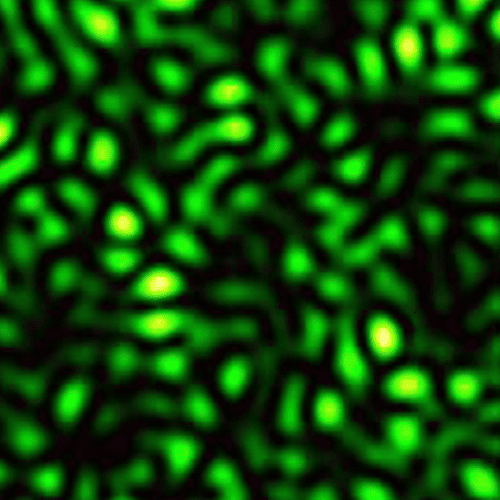
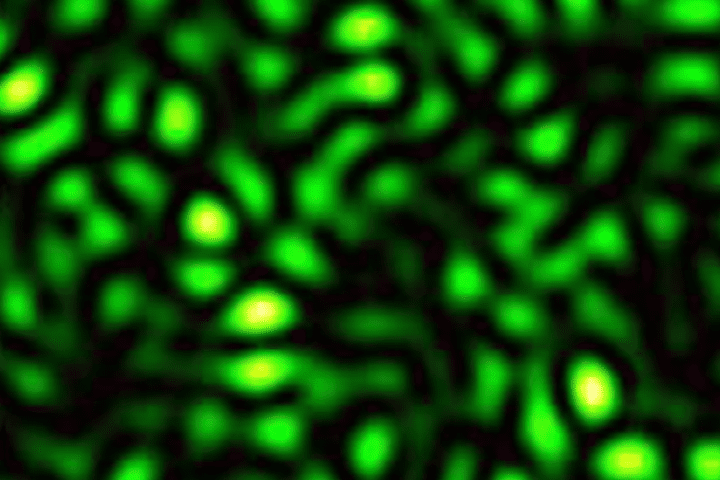
Figure 1: Laser light passing through an opaque layer such as a piece of paper creates a speckled wave pattern.
Laser light passing through an opaque layer creates a speckled light pattern behind the layer. Although this speckled light pattern gives the impression of being completely random, as seen in Figure 1, it contains certain correlations, resulting in what is called an ‘angular memory’: as seen in Figure 2 (a), tilting the incident laser beam on the opaque layer surface with a small angle yields the same transmitted speckle pattern but with an angular tilt. The direction and angle of this tilt behind the opaque layer are the same as the tilt direction and angle at the input. Thanks to the new approach by the international research team, it is now possible that the speckle pattern formed on the back can be tilted in any desired direction, regardless of the tilt angle and direction of laser light incident on the opaque surface. The core ingredient of the new method is the “transmission matrix” of the opaque layer, which gives the relationship between the laser light incident on the opaque surface and the laser light passing behind it. Using the experimentally determined transmission matrix, laser light incident on the surface is spatially shaped using a device called spatial light modulator (SLM). This spatially shaped light customizes the angular memory effect, allowing the transmitted speckle to behave as desired.
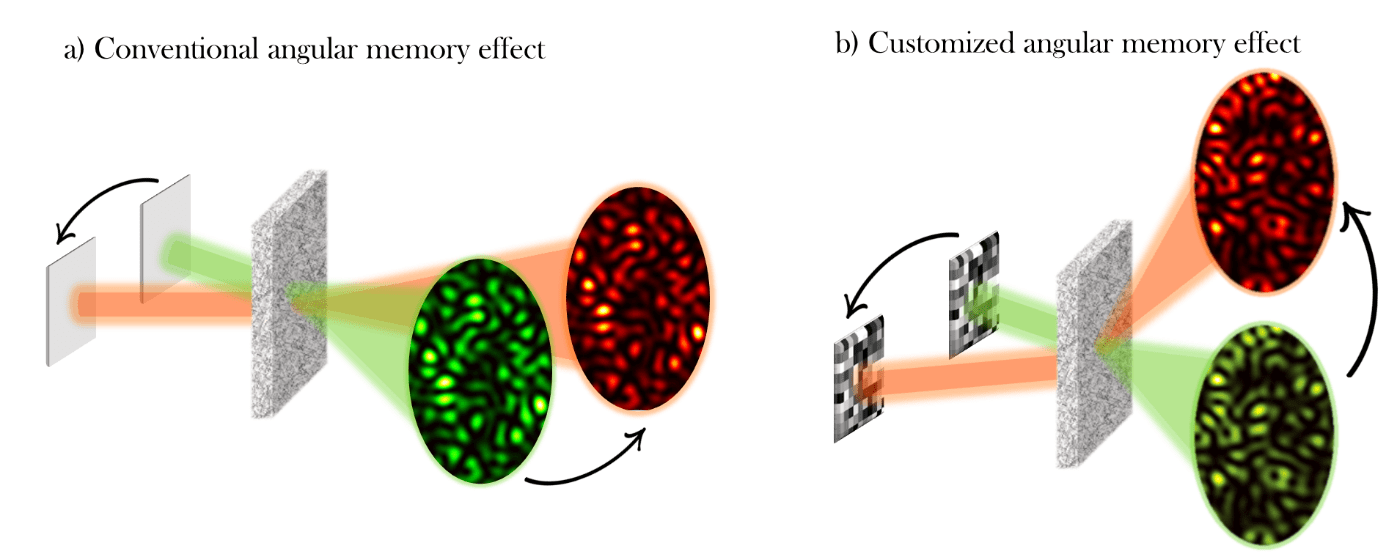
Figure 2: (a) When a laser beam incident on an opaque layer is tilted at a small angle, the speckle pattern formed on the back tilts in the same direction and angle. (b) The beam of laser light shaped by the spatial light modulator enables the transmitted speckle pattern to tilt at a customized angle and direction.
The first author of the article, Dr. Hasan Yılmaz, currently an assistant professor at Bilkent University, UNAM, summarizes the study as follows: ‘‘The previously accepted view from the scientific community was that the angular memory effect is a physical feature of the opaque material and therefore the performance of the imaging methods using this memory effect is limited by the physical properties of the material. In our study, we have shown that this view is much too pessimistic: the angular memory of the light waves passing through the opaque layer can be modified independently of the physical properties of the opaque material, only by controlling the shape of the incident light,” The corresponding author of the article, Prof. Hui Cao from Yale University, says: “Our method has the promising feature that it can also be used for different memory effects in other complex systems such as optical fibers and chaotic systems.”
The work is a joint project with the theory group led by Prof. Stefan Rotter from Vienna University of Technology (Austria). Dr. Rotter remarks: ‘‘The results now achieved nicely demonstrate the power of spatially shaping light waves; moreover, they also raise a multitude of follow-up questions such as whether the memory effect in the transmitted output speckle pattern also has interesting consequences for the light fields inside the opaque medium. There are certainly many open questions yet to be explored.’’
Another application of the new method is in quantum information science. Previously, researchers demonstrated that the angular memory effect is present also for quantum light through scattering media. Using the new method, quantum angular correlations of entangled photons that are scattered through a complex medium can be customized. Such freedom of modifying quantum correlations will have applications in quantum imaging and metrology.
The Physical Review X Publication: https://link.aps.org/doi/10.1103/PhysRevX.11.031010
