
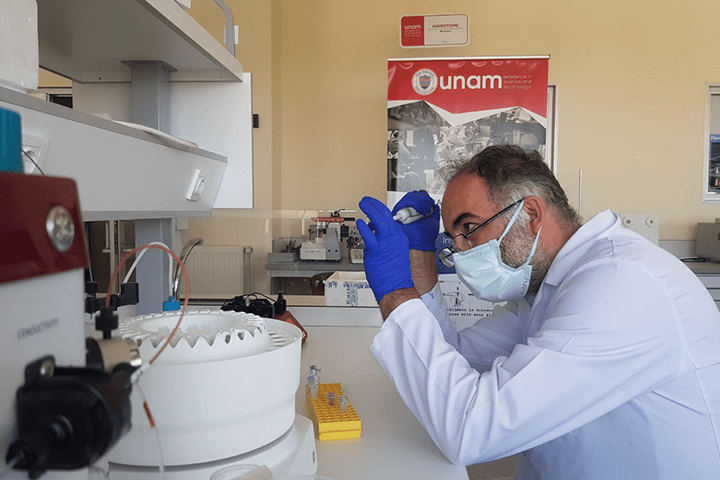
A nasal spray that prevents the entry of the coronavirus into the cell has been developed at Bilkent University’s National Nanotechnology Research Center (UNAM) in cooperation with Ankara and Hacettepe Universities. The studies for the nasal spray, whose preclinical studies have been successful up to this point, will continue with further clinical studies and will begin to be administered to volunteers after applying to the Ministry of Health.
A protein called Griffthsin was obtained using the recombinant DNA method, which involves cutting DNA molecules obtained from different biological species with genetic engineering technology and combining the different DNA fragments. This protein molecule, when squeezed into the nasal cavity, will prevent the virus from entering the cell. For the preclinical test studies of the drug, the production and design of the drug were conducted by Bilkent University’s UNAM; animal experiments were carried out by Ankara University’s Faculty of Veterinary Medicine; and the histological changes in the cell and viral replications on different organs were examined at Hacettepe University. An application for the phase study, which will enable the drug to be tested on humans, is planned to be made soon.
When the spray is applied to the nose in the first stage of the disease, the virus can be destroyed by the body by preventing it from entering the cell and multiplying. This drug, which is effective against coronavirus and is aimed to have a protective effect against its variants, is expected to be in use by December of this year, assuming a timely completion of the studies and necessary permits.
