
- This event has passed.
Basic sciences: The mission of homo sapiens in the universe
16 May 2024 @ 08:00 - 17:00

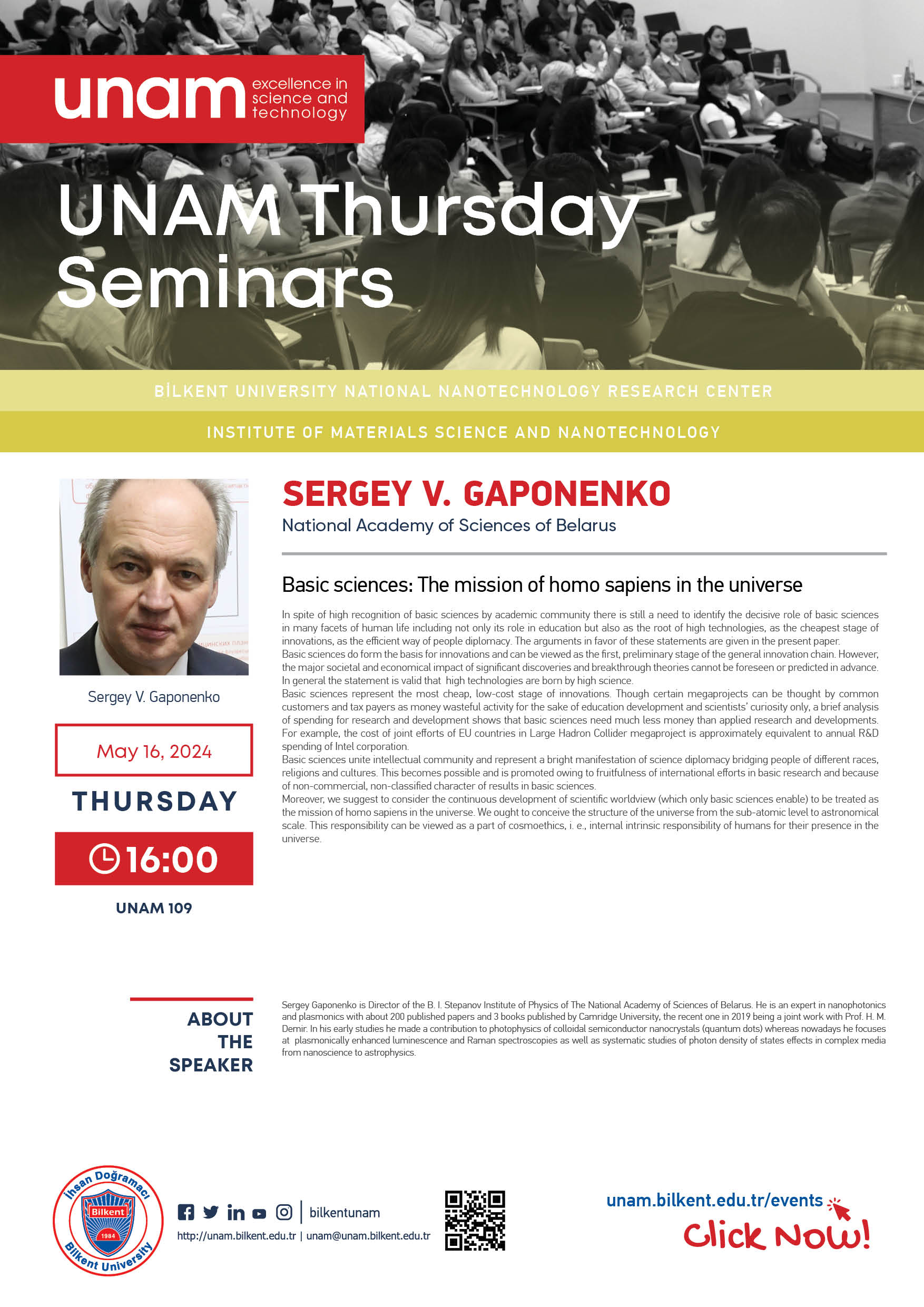
Sergey V. Gaponenko
National Academy of Sciences of Belarus
Basic sciences: The mission of homo sapiens in the universe
In spite of high recognition of basic sciences by academic community there is still a need to identify the decisive role of basic sciences in many facets of human life including not only its role in education but also as the root of high technologies, as the cheapest stage of innovations, as the efficient way of people diplomacy. The arguments in favor of these statements are given in the present paper.
Basic sciences do form the basis for innovations and can be viewed as the first, preliminary stage of the general innovation chain. However, the major societal and economical impact of significant discoveries and breakthrough theories cannot be foreseen or predicted in advance. In general the statement is valid that high technologies are born by high science.
Basic sciences represent the most cheap, low-cost stage of innovations. Though certain megaprojects can be thought by common customers and tax payers as money wasteful activity for the sake of education development and scientists’ curiosity only, a brief analysis of spending for research and development shows that basic sciences need much less money than applied research and developments. For example, the cost of joint efforts of EU countries in Large Hadron Collider megaproject is approximately equivalent to annual R&D spending of Intel corporation.
Basic sciences unite intellectual community and represent a bright manifestation of science diplomacy bridging people of different races, religions and cultures. This becomes possible and is promoted owing to fruitfulness of international efforts in basic research and because of non-commercial, non-classified character of results in basic sciences.
Moreover, we suggest to consider the continuous development of scientific worldview (which only basic sciences enable) to be treated as the mission of homo sapiens in the universe. We ought to conceive the structure of the universe from the sub-atomic level to astronomical scale. This responsibility can be viewed as a part of cosmoethics, i. e., internal intrinsic responsibility of humans for their presence in the universe.
About speaker
Sergey Gaponenko is Director of the B. I. Stepanov Institute of Physics of The National Academy of Sciences of Belarus. He is an expert in nanophotonics and plasmonics with about 200 published papers and 3 books published by Camridge University, the recent one in 2019 being a joint work with Prof. H. M. Demir. In his early studies he made a contribution to photophysics of colloidal semiconductor nanocrystals (quantum dots) whereas nowadays he focuses at plasmonically enhanced luminescence and Raman spectroscopies as well as systematic studies of photon density of states effects in complex media from nanoscience to astrophysics.