How does self-organization reduce entropy?

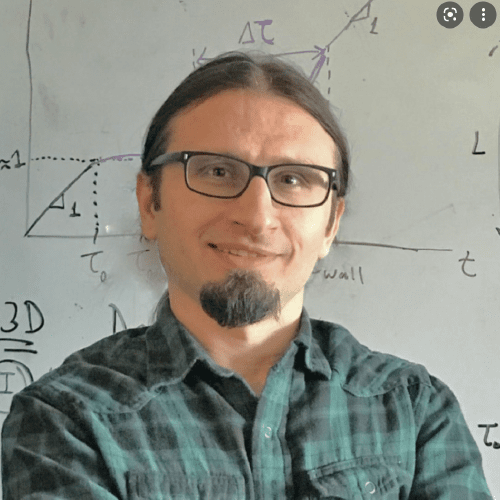
ÖMER İLDAY MSN Graduate Program and UNAM Self-organization is the spontaneous emergence of an ordered state. Despite its ubiquity, how self-organization reduces entropy was never clarified. In this talk, we present a new theoretical framework, whereby we decompose a self-organized system into two parts, one that gets ordered and another that reduces the entropy of […]


Exploring electronic correlations in low dimensional materials

T. SERKAN KASIRGA MSN Graduate Program and UNAM Strong electronic correlations among various degrees of freedoms in solids result in the emergence of fascinating phenomena. To name a few we can list metal-insulator transitions, charge density wave transitions and superconductivity. However, these phenomena are notoriously difficult to study experimentally as they are typically associated with […]

Plasmon-Enhanced Light-Matter Interactions at the Nanoscale

Wonmi Ahn MSN Graduate Program and UNAM Noble metal nanoparticles supporting collective oscillations of conduction electrons, i.e., surface plasmon resonances, exhibit excellent light-focusing ability and high spectral sensitivity to changes in the surrounding medium. These capabilities explain the increasing role of plasmonic nanomaterials in nanoimaging, sensing, energy, and biomedical applications. However, high dissipative losses in […]

Control of Static Electricity By Light and Polymer Mechanochemistry

Bilge Baytekin MSN Graduate Program and UNAM The mechanism of static electricity generation and mitigation on insulator surfaces upon rubbing/contact is one of the few scientific questions that have remained unanswered for millennia. Static charging (tribocharging) of insulators is not just a scientific mystery – it is also a significant problem, especially critical for various […]

What can we learn from computational cell models?

Aykut Erbaş MSN Graduate Program and UNAM There are over 40 million cells in our body. Despite carrying an identical genome, these cells are specialized into 200 different types to undertake particular biological tasks in various tissues. The main factor determining a cell’s biological identity is the type and amount of cell-specific proteins. In turn, […]

Fibers for optics and structures

Hasan Yılmaz MSN Graduate Program and UNAM Optical fibers are versatile waveguides that have numerous application areas such as telecommunication, lasers, biomedical and infrared (IR) optics. Hollow-core optical fibers (HCFs) are microstructured fibers with a hollow-core surrounded by cladding elements that further diversify the applications of fibers in nonlinear optics, chemical sensing, plasma generation and […]

Logistic Cellular Automata

Seymur Jahangirov MSN Graduate Program and UNAM Imagine a system that consists of interconnected cells each having an inner state. The inner state of each cell is changed based on the inner states of a specific subset of cells according to a certain rule. This is a general definition of cellular automata. Now replace those […]